
US Unemployment Insurance Weekly Claims | July 18 2026

US Unemployment Insurance Weekly Claims | July 18 2026 Understanding the Dynamics of Unemployment Insurance Claims In an evolving economic landscape, the role o…
US Unemployment Insurance Weekly Claims | July 18 2026
Understanding the Dynamics of Unemployment Insurance Claims
In an evolving economic landscape, the role of unemployment insurance claims has never been more critical. As global events continue to influence job markets, individuals and businesses must navigate these challenging times with informed resources. Unemployment insurance acts as a vital safety net, providing essential support for those facing unforeseen job losses.
The recent report from the U.S. Department of Labor provides a detailed overview of the current trends in unemployment insurance claims. This document, accessible at https://www.dol.gov/sites/dolgov/files/OPA/newsreleases/ui-claims/20261263.pdf, highlights significant data points and trends that are shaping the workforce economy. By analyzing these trends, stakeholders can better understand how economic shifts impact employment patterns and the overall economy.
Moreover, understanding the intricacies of unemployment claims is crucial for both job seekers and employers. Job seekers can gain insights into which sectors are experiencing fluctuations, helping them target their job searches more effectively. For employers, staying informed about these dynamics is essential for strategic planning, enabling them to navigate operational challenges during periods of economic uncertainty.
According to recent data, unemployment insurance claims have shown varied trends across different regions, reflecting local economic conditions and policy responses. For example, CNBC reports a decline in claims as labor markets demonstrate resilience. This underscores the importance of regional economic policies and their effectiveness in addressing unemployment.
In addition, the integration of digital tools in processing claims has streamlined administrative processes, significantly reducing the time required for claimants to receive benefits. The advent of online platforms has transformed the way individuals interact with unemployment insurance, making it more accessible and efficient. Resources such as the "From Tradition To Innovation Why Digital Gold Is The Next Big Investment Trend" page highlight the broader trends in digital transformation, emphasizing the importance of embracing innovative solutions in traditional industries.
As we delve deeper into the trends and implications of these unemployment insurance claims, it becomes evident that understanding and analyzing these reports is key to strategic planning for individuals and businesses alike. For more comprehensive insights on the broader economic trends, explore related topics and expert analyses available through reliable sources and industry reports.
Analyzing the Economic Impact of Unemployment Claims
Understanding the implications of unemployment insurance claims, such as those reported in the recent Department of Labor release, is crucial for comprehending the broader economic landscape. These reports provide insights into the health of the labor market and serve as indicators of economic stability or turmoil. By assessing these data, businesses and policymakers can make informed decisions that align with current economic conditions.
The Role of Unemployment Data in Economic Strategy
Unemployment claims data offers a window into the workforce dynamics influencing economic strategy on both a macro and microeconomic level. For instance, a sudden spike in claims might signal an economic downturn, prompting businesses to reassess their hiring strategies and financial forecasts. On the other hand, a decline in claims could indicate an economic recovery, encouraging companies to expand operations or invest in new projects.
Case Studies: Businesses Adapting to Claim Trends
A practical example is the retail sector, which often adapts staffing and inventory practices based on economic indicators. During the 2008 financial crisis, many retail companies, confronted by rising unemployment claims, streamlined operations and focused on core profitable products. In contrast, when unemployment rates began to drop several years later, these companies expanded their workforce and inventories to accommodate increased consumer demand.
Actionable Insights for Businesses
Analyzing trends in unemployment claims can offer actionable insights for businesses. By closely monitoring these data, businesses can better anticipate shifts in consumer behavior and adjust their strategies accordingly. For example, companies might consider flexible staffing solutions, leveraging part-time or contractual hires to manage economic uncertainty. Additionally, investing in technology to enhance operational efficiency can help businesses weather economic fluctuations.
Future Economic Indicators to Watch
Looking ahead, it’s vital to keep an eye on emerging economic indicators that correlate with unemployment data. Factors such as technological innovation, policy changes, and global economic trends can profoundly affect the labor market. Businesses should adopt a proactive approach, preparing for potential shifts by exploring diverse revenue streams and cultivating a resilient organizational structure. For further insights, companies might explore strategic investments, such as digital gold investments, which are becoming increasingly popular as a hedge against economic instability.

A close-up image of a stack of filed unemployment claim forms stamped with "Processed" in red, resting on a wooden table next to a coffee mug and a small potted plant.
The Role of Data in Unemployment Claims
Analyzing unemployment claims data provides crucial insights into economic health and workforce trends. The report from the Department of Labor offers detailed statistics on claims, reflecting both short-term economic pressures and longer-term shifts in employment patterns. For instance, fluctuating claim numbers can signal structural changes in the job market, such as technological advances impacting specific sectors. Understanding these data trends enables policymakers and businesses to make informed decisions regarding workforce development and economic strategies.
Leveraging Technology for Data Interpretation
In the age of big data, leveraging technology to interpret unemployment statistics is essential. Using sophisticated data analytics tools, analysts can identify patterns, predict future trends, and offer actionable insights. Platforms like Just Gold provide innovative solutions to streamline data analysis processes. By capitalizing on these tools, companies and government agencies can enhance their strategic planning and response capabilities, ensuring they remain agile in a rapidly changing economic environment.
Case Studies of Effective Data Utilization
Several countries have successfully used unemployment data to shape public policy. For example, during economic downturns, adopting targeted fiscal policies based on detailed claims data has proven effective in mitigating unemployment spikes. Additionally, businesses in the gig economy can benefit from understanding these data trends to navigate labor demand fluctuations effectively. Such strategies not only stabilize employment rates but also bolster economic resilience. To explore more about how digital solutions facilitate real-time investment analysis, check out How Digital Gold Brings 24/7 Investing Power To Your Phone.
The integration of comprehensive data analysis into unemployment claim evaluations continues to prove vital. Policymakers armed with this data can craft more effective intervention strategies, while businesses are empowered to adapt proactively to market changes.
Enhancing Unemployment Analytics Through Technology
Technology plays a central role in revolutionizing how unemployment data is collected, analyzed, and applied. The integration of advanced analytics platforms allows agencies to process vast datasets expediently. One notable application is the utilization of predictive analytics tools, which help forecast trends in unemployment rates by examining historical data and current economic indicators.
According to the Department of Labor's report, the precision of predictive models has increased significantly. By leveraging machine learning algorithms, analysts can now identify patterns that were previously undetectable. This capability enables policymakers to anticipate job market shifts, aligning intervention strategies more effectively with economic realities.
Case Study: Implementation in State Agencies
Several state labor agencies have successfully integrated these technologies, setting precedents for others to follow. For instance, California’s Employment Development Department (EDD) adopted a comprehensive data analytics approach, leading to more informed policy decisions and resource allocation. A detailed report from the EDD highlighted a significant reduction in processing times for unemployment claims, demonstrating the tangible benefits of these technologies (EDD, 2023).
This transition to a digital-first strategy mitigates delays and enhances the user experience for claimants. Moreover, these improvements facilitate a more proactive approach to managing unemployment, allowing for swifter response times to any sudden economic changes, such as those observed during the COVID-19 pandemic.
Driving Business Adaptation
Innovation in unemployment data handling also provides critical insights for businesses. Firms can leverage this data to better understand unemployment trends and refine their workforce strategies. For instance, during economic downturns, companies might explore options to reskill employees rather than pursue layoffs, a strategy supported by Deloitte’s research which emphasizes the value of adaptability in workforce management.
Furthermore, by assessing detailed unemployment statistics, organizations can identify areas with a surplus of qualified labor, allowing for strategic relocation or expansion. Businesses that adapt swiftly to labor market dynamics often find themselves ahead of the competition, turning challenges into strategic advantages.
As digital integration continues to transform the unemployment landscape, exploring how these technologies fortify economic resilience is essential. To further understand the implications of digital gold in economic strategies, consider reading about why investors are moving to digital gold GCC.
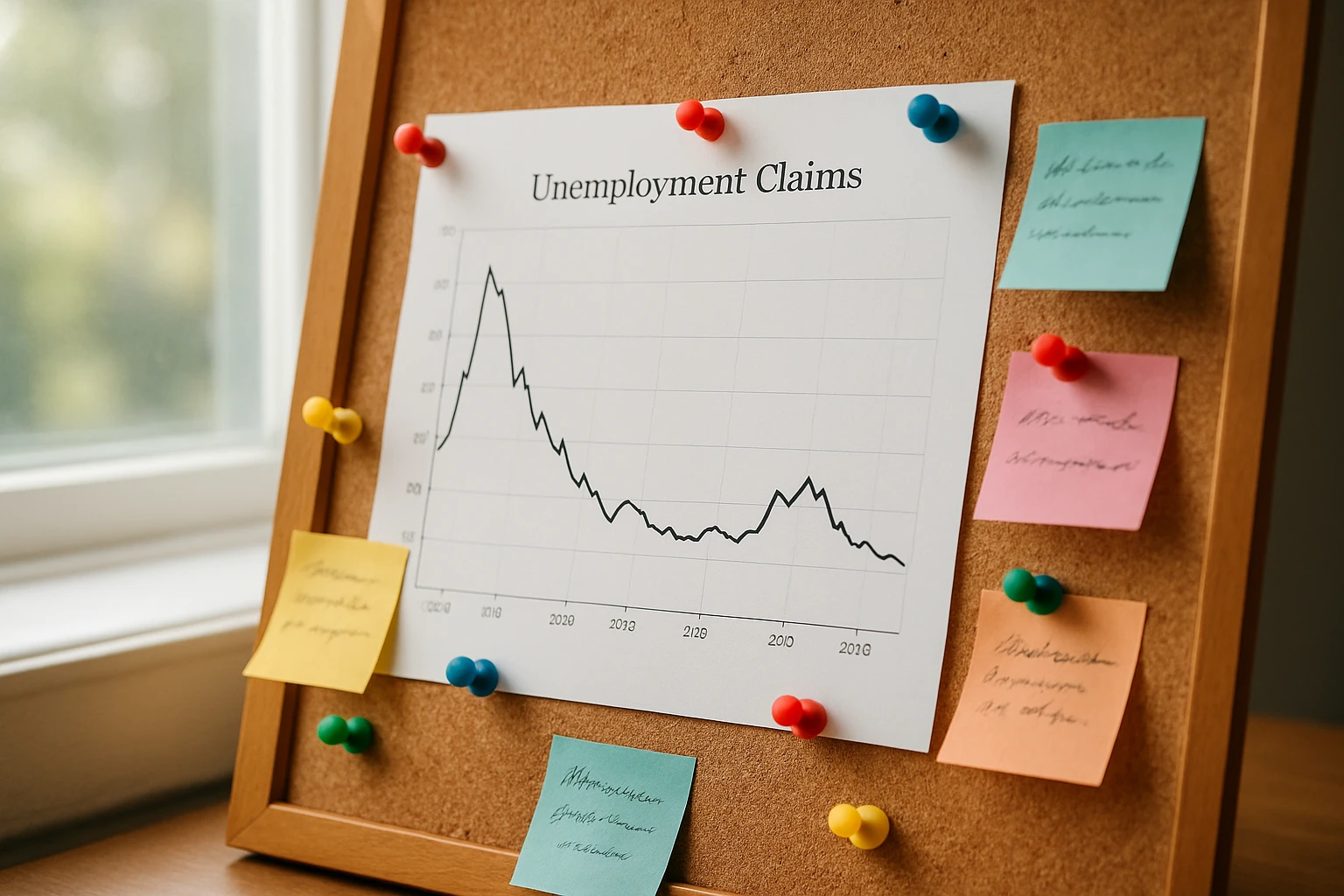
A graph printed on crisp paper showing trends in unemployment claims, pinned to a corkboard surrounded by colorful pushpins and sticky notes with handwritten economic forecasts, leaning against a bright window with natural light.
Conclusion: Navigating Economic Transitions
The data outlined in this report provides crucial insights into the trends shaping our economic landscape. Understanding these patterns is vital for policymakers, businesses, and individuals alike. The fluctuations in unemployment claims highlight economic vulnerabilities that need strategic handling. By analyzing these trends, stakeholders can better navigate future challenges.
One actionable insight is the need for diversified employment strategies. Economic resilience can be strengthened through flexible policies and by fostering skill development that aligns with shifting market demands. For instance, regions heavily reliant on particular industries could benefit from incentives promoting alternative sectors to mitigate economic shocks.
Another takeaway involves the importance of timely intervention. The swift response to initial unemployment spikes during economic downturns has shown to significantly affect recovery outcomes. This requires a robust framework for monitoring labor market conditions and deploying targeted support efficiently. According to a study by the Brookings Institution, proactive measures during early economic distress phases are crucial for long-term stability.
For businesses, understanding these economic signals can inform strategic planning and risk management. Emphasizing employee training and adopting technology solutions can enhance competitiveness and adaptability. Moreover, businesses should consider leveraging analytical tools to better anticipate economic trends, thereby remaining agile in response to market changes.
As a recommended resource, exploring platforms like Just Gold can provide comprehensive support in implementing these strategies. By utilizing tailored services offered by platforms such as Just Gold, both businesses and individuals can optimize their approach to the evolving economic environment, ensuring sustained growth and resilience.
In conclusion, leveraging the insights from the unemployment claims report is a strategic step towards enhancing economic stability and progress. By focusing on diversified strategies, timely interventions, and embracing technological advancements, stakeholders can navigate economic transitions more effectively, paving the way for robust economic health.