
Tracking Gold Prices Daily: What Long Term Investors Watch
Tracking gold prices daily is not about reacting to short term price movements or timing the market. For long term investors, it is a way to understand macroeco…
Tracking gold prices daily is not about reacting to short term price movements or timing the market. For long term investors, it is a way to understand macroeconomic signals, market sentiment, and trends that influence portfolio stability.
What is the gold price and how is it set?
Gold is priced globally in US dollars per troy ounce and trades continuously across international markets. This headline price reflects market expectations around interest rates, currency strength, inflation, and geopolitical risk.
Unlike many assets, gold often responds clearly when these forces move in different directions. Changes in gold prices can reveal whether markets are more focused on inflation, monetary policy, or financial stability at a given time.
Why have gold prices remained elevated?
Over the past year and into 2025, global markets have faced persistent inflation, shifting interest rate expectations, and geopolitical uncertainty. In this environment, gold has remained close to historic highs rather than retreating alongside more speculative assets.
This behaviour has been consistent across multiple market cycles rather than driven by a single event. Gold’s strength reflects its traditional role as a stabilising asset that tends to behave predictably when other asset classes experience volatility.
How do investors track live gold prices?
Investors typically begin by tracking live spot prices. Platforms such as GoldPrice.org and Kitco provide real time gold prices across major currencies, including US dollars and UAE dirhams, as well as per gram pricing that is widely used in the GCC.
Intraday charts help investors see not just direction but behaviour. Gradual moves often suggest underlying structural demand, while sharp spikes are more likely linked to short term news or risk events.
Why does macroeconomic context matter for gold?
More advanced investors analyse gold alongside indicators such as US Treasury yields, the US dollar index, and market based inflation expectations. Professional platforms like Bloomberg and Refinitiv make these relationships easier to monitor.
Context matters because similar price movements can signal different dynamics. A rise in gold during periods of falling real yields tells a different story than a rally driven primarily by geopolitical headlines or short lived risk aversion.
What can central bank and demand data tell investors?
For longer term decisions, investors look at structural demand data, including central bank purchases, ETF flows, jewellery demand, and regional consumption trends. Publicly available reports from organisations such as the World Gold Council are commonly used for this analysis.
Central banks, particularly in emerging markets, have been steadily increasing their gold reserves in recent years. This quiet accumulation supports prices over time and often explains resilience that day to day market movements alone do not capture.
How do local factors in the UAE and GCC affect gold prices?
In the UAE, investors follow rates published by the Dubai Gold and Jewellery Group as a key daily reference. While global benchmarks set overall direction, local retail prices reflect regional demand, logistics, and seasonal buying patterns.
Weddings, religious festivals, and peak travel periods can all influence local gold demand. As a result, even modest global price changes can translate into noticeable differences at the retail level in the GCC.
What do gold futures markets show?
Gold futures provide additional insight by revealing how traders are positioned. Contracts traded on the Dubai Gold and Commodities Exchange, in both US dollars and UAE dirhams, offer information on expectations and hedging activity.
Globally, COMEX futures serve a similar role. Futures markets do not predict outcomes, but they help investors understand positioning, sentiment, and the balance between hedging and speculation.
How should technical indicators be used for gold?
Some investors track technical indicators such as moving averages, momentum metrics, and support or resistance levels. These tools do not forecast the future, but they help gauge whether conviction behind a price move is strengthening or fading.
Because gold is highly liquid and widely followed, these reference levels are observed by many market participants. Used alongside fundamentals, they add context rather than replacing long term analysis.
How has technology changed gold price tracking?
Modern tools have made tracking gold prices continuous and accessible. Prices refresh in real time, alerts can be set for specific levels, and decades of historical data are readily available.
For GCC investors, this accessibility is particularly useful because global markets are active while the local day is still unfolding. The real benefit comes from using these tools to recognise patterns over time rather than reacting to every movement.
How does daily tracking help long term investors?
Daily tracking of gold prices is not about frequent trading or short term decision making. It is about observing how gold behaves relative to risk assets, inflation, and monetary conditions over extended periods.
Questions such as whether gold is moving independently from equities, or whether changes in interest rates are starting to matter more than inflation, are best answered through consistent observation rather than short term reactions.
Where do digital gold platforms fit into this?
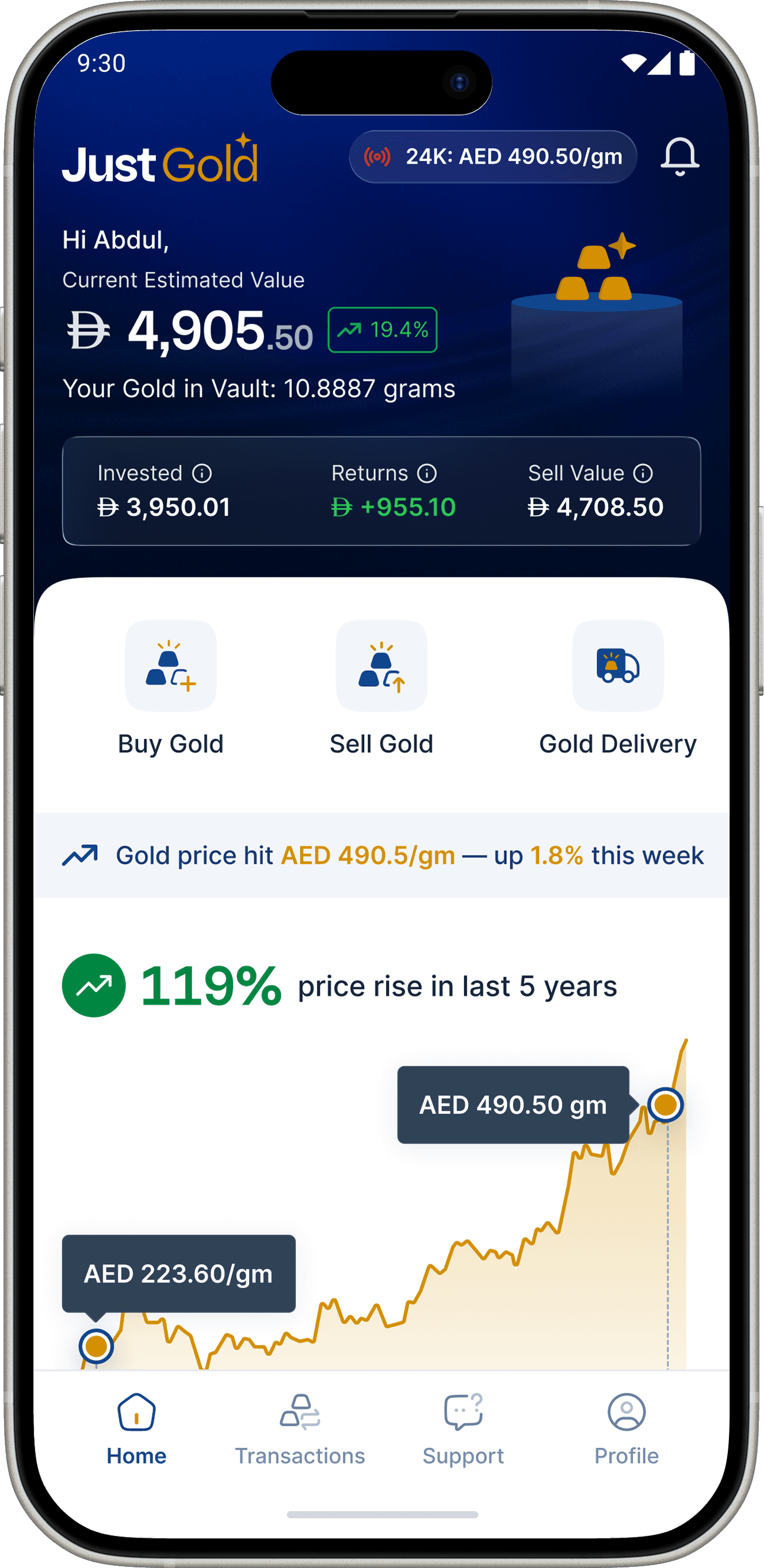
Digital gold platforms can support this disciplined approach by combining transparent, real time pricing with the ability to buy precise amounts of gold. Investors can hold gold digitally, sell efficiently when needed, or redeem physical gold according to platform terms.
For UAE residents, structural features such as transparent local pricing and the absence of personal capital gains tax on gold price appreciation make digital ownership attractive as part of a long term savings strategy.
Conclusion
Gold continues to endure as an asset because of its transparency, liquidity, and consistency across market cycles. For long term investors, tracking gold prices daily is not about chasing returns, but about staying informed and grounded as economic conditions evolve.
The most effective way to own gold is to treat it as a stabilising component within a broader financial strategy, supported by disciplined observation, clear pricing, and a long term perspective.