
When Other Assets Falter, Gold Endures, Including in Digital Form
Many investors arrive at a similar reflection when reviewing past market cycles: owning more gold earlier could have meaningfully improved long term outcomes. I…
Many investors arrive at a similar reflection when reviewing past market cycles: owning more gold earlier could have meaningfully improved long term outcomes. In 2015, when gold traded around AED 135 to 150 per gram, attention often focused instead on equities, real estate, or newer asset classes that appeared to offer faster gains.
Gold, by comparison, seemed uneventful. Yet it quietly did what it has historically done best: preserve value across changing economic conditions.
What long term ownership can illustrate
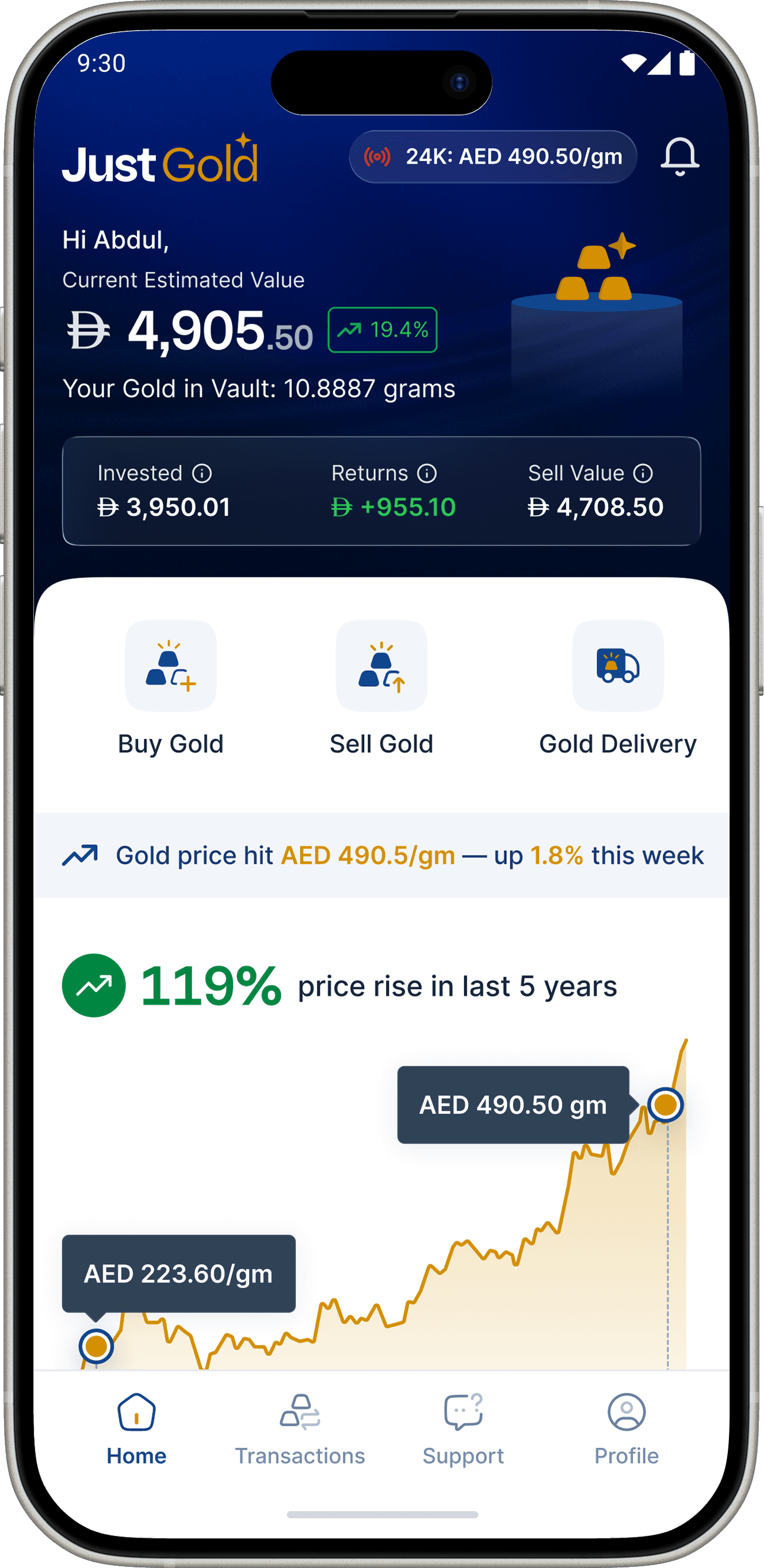
Consider an illustrative historical example. An investment of AED 10,000 in gold in 2015, at an approximate price of AED 140 per gram, would have resulted in ownership of around 71 grams of gold. At more recent price ranges in the UAE, those same holdings would be valued significantly above the original investment, even after accounting for periods of volatility.
This outcome does not rely on frequent trading or precise market timing. It reflects patient ownership across multiple market cycles. The figures are approximate and based on historical prices. They are for illustration only and do not represent a forecast. Past performance does not guarantee future results.
How gold has compared with other assets
Over the same decade, other asset classes experienced sharper swings. Equity markets delivered periods of strong performance followed by notable corrections. Real estate appreciated in many markets, but often required substantial capital, long holding periods, and limited liquidity. Cash and savings accounts frequently struggled to keep pace with inflation.
Gold followed a different pattern. While not immune to volatility, its behaviour during episodes of broader market stress was often more resilient, and its value tended to hold up when multiple risk assets moved in the same direction. This is why gold is frequently described as an asset that rewards patience and long term perspective rather than short term prediction.
Why gold continues to play this role
Gold’s behaviour is rooted in characteristics that are difficult to replicate. It is scarce, globally recognised, and not dependent on the creditworthiness of any single institution or government. When currencies weaken, inflation rises, or confidence in financial markets is tested, gold has historically attracted renewed demand as a neutral store of value.
These attributes explain why gold has maintained relevance across generations. Its role is less about rapid wealth creation and more about preserving purchasing power and providing an anchor when other assets are influenced by policy shifts or market sentiment.
Structural advantages for investors in the UAE
For investors in the UAE, gold ownership offers additional structural benefits. The local gold market is known for transparent pricing, deep liquidity, and strong integration with global benchmarks. Residents also benefit from the absence of personal capital gains tax on gold price appreciation, which can enhance after tax outcomes relative to some other jurisdictions.
Historically, investors travelled to Dubai specifically to access these advantages. Today, local investors can benefit from the same conditions more efficiently, without relying on physical markets or managing storage themselves.
How digital gold adapts traditional ownership
Digital gold adapts traditional gold ownership to modern financial habits. Instead of requiring large, infrequent purchases and personal safekeeping arrangements, investors can acquire smaller quantities of physical gold through regulated platforms and build positions gradually.
In these structures, ownership is recorded digitally, while the underlying gold is held in secure, insured custody on the investor’s behalf. This approach simplifies monitoring, facilitates portfolio rebalancing, and provides access to liquidity when required, while retaining exposure to physical bullion rather than synthetic instruments.
Why gold is being rediscovered, not reinvented
Gold’s renewed relevance is not driven by novelty. It reflects a broader shift in investor priorities toward resilience and predictability during periods of cyclical uncertainty. When inflation, interest rates, and geopolitical risks become more prominent, assets with long records of defensive behaviour tend to regain attention.
Digital formats do not replace traditional gold. They make ownership more accessible and better aligned with how diversified portfolios are managed today, where investors often combine multiple asset classes across traditional and digital channels.
A long term perspective on starting
Among long term gold holders, the most common regret is rarely about missing the exact lowest price. More often, it is about delaying the initial decision to allocate.
Gold does not aim to deliver excitement or short term outperformance. Its value lies in consistency, resilience, and its ability to remain relevant through alternating phases of optimism and stress in other markets. Digital access does not change that principle. It lowers the barriers to participation, making it easier to start with smaller amounts and integrate gold into a disciplined savings or investment strategy.
Conclusion
Gold has endured across centuries because it fulfils a specific function: preserving value when confidence in other assets is uncertain. That function remains intact even as ownership evolves from purely physical holdings to digital formats backed by physical bullion.
For investors who prioritise stability over speculation, gold continues to offer a long term anchor within a diversified portfolio. Digital platforms make that anchor easier to hold and manage, but the underlying logic remains unchanged. When markets are unpredictable, assets that do not depend on precise prediction tend to matter most.